Introduction
The name of this site is a joke I have been making with myself for about a decade now…
I spent twelve years as an FBI Special Agent investigating people who do terrible things to each other in the name of various noble-sounding ideas. The longer I did that work, the more I started to notice that the ideas were almost beside the point. What I was actually watching was one particular mode of being human: competitive, hierarchical, loyal inside the group and lethal outside it. It kept turning up across populations that had nothing else in common. After a while I started reading about our closest primate cousins, and I realized I had been watching the chimpanzee mode of being human, expressed by people who thought they were doing something else entirely.
We have another mode available to us, and the bonobos are the proof of it. What follows is a long attempt to work out why we keep choosing the first one.
A note on the name
Chimpanzees and bonobos are the two living primates closest to humans. We share roughly 98% of our DNA with each of them. They diverged from a common ancestor somewhere between 1.5 and 2 million years ago, which sounds like a long time but isn’t; in evolutionary terms the two are still recognizably the same kind of creature. They look alike, they think in similar ways, and they share most of their cognitive architecture.
And yet they organize their social worlds in opposite directions.
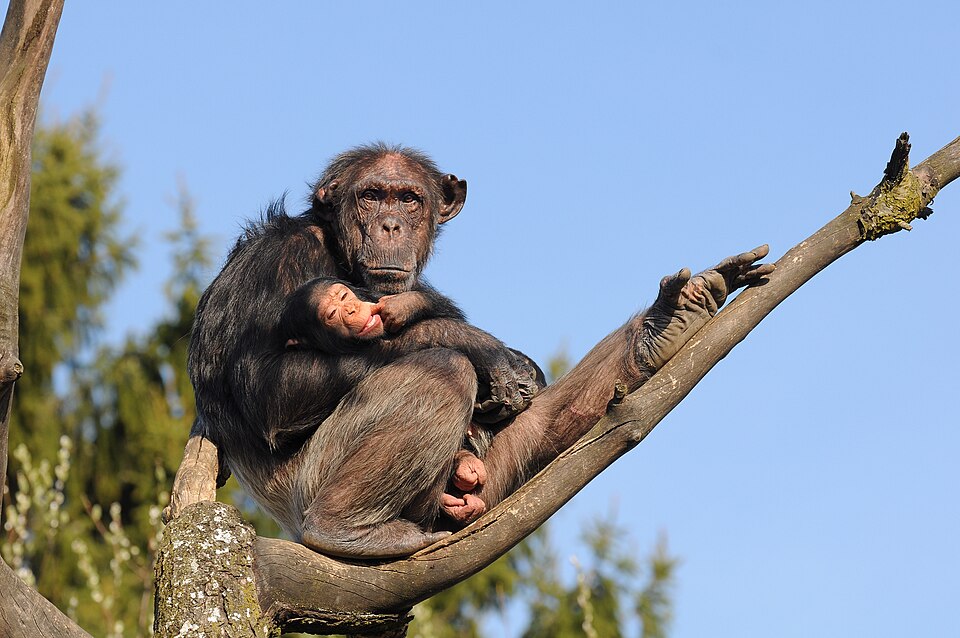
Chimpanzees live in male-dominated hierarchies. They hunt cooperatively but compete fiercely, they patrol territory, and they conduct lethal raids on neighboring groups. In the unsentimental phrase the primatologists use, they are demonic: capable of warfare in the recognizable human sense.
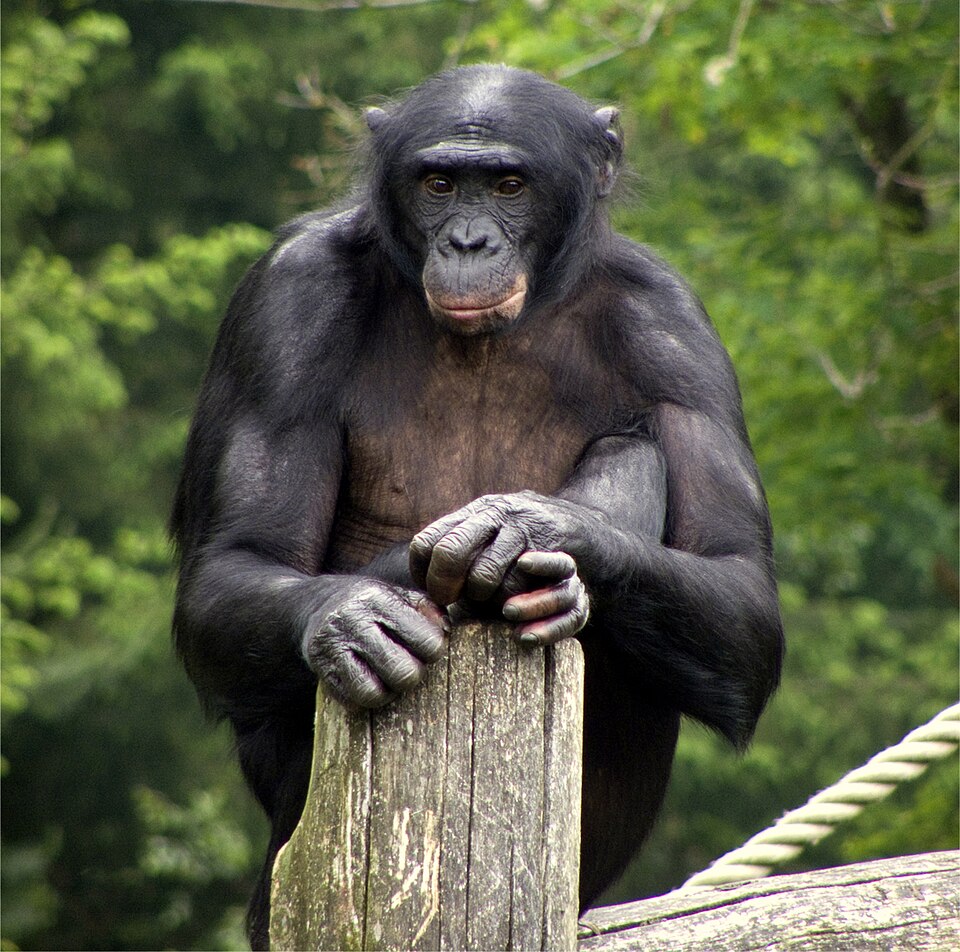
Bonobos live in female-led communities. They share food readily. Conflict between groups gets settled by affiliation rather than fighting — sometimes, famously, through sexual behavior. It’s a joke I make with friends: if bonobos had been cast in the Planet of the Apes franchise… the movies would never have made it into theaters.
Recent work has complicated the older picture. Mouginot et al. (2024) found that male bonobos engage in more frequent low-level aggression with other males than chimpanzees do, and a 2026 paper (Gareta García et al.) documented the first death arising from an encounter between communities. The overall shape still holds, though. Bonobo aggression is overwhelmingly male-male inside a single community, and it does not produce the organized border patrols and repeated territorial raids that define the chimpanzee pattern. Coalitions are not the dividing line, and neither are lethal outcomes: in that 2026 case a coalition from one community attacked a female of another and her infant died. One incident across decades of observation, against a behavior chimpanzees perform routinely, is a difference in frequency rather than in kind. Whatever else they are, bonobos are not the cartoon peaceniks of the early literature. They are an ape whose aggression takes a different form, in a different social structure, under a different resource environment — and that difference is the whole point of the comparison.
Both species are correctly adapted to the environments that produced them, and neither is morally superior to the other. But humans, unlike either cousin, are configurable. We carry both possibilities, and which one expresses depends in large part on the signals our biology is receiving about the world around it.
This site argues that we have been receiving the wrong signals for a long time, and that the cost of that has been higher than we have admitted. Less chimp, more bonobo is a proposal, and I mean it literally.
How I actually use this
Before the science, a practical note.
Over the years I’ve started, half-consciously, to place the people and groups I encounter on a spectrum running from chimp to bonobo. The longer I do it the more useful it gets, less as a diagnosis of anyone than as a way of locating behavior.
Hot-tempered, quick to anger, loud, territorial about possessions, prone to dominance display, escalating a conflict rather than dissolving it: that is chimp-leaning behavior. It isn’t bad and it isn’t pathological. It’s just chimp-configured.
Patient, slow to react, empathetic, easy to share with, inclined to defuse a conflict before it has fully formed — bonobo-leaning. Which is not the same thing as saintly, and definitely not the same thing as weak.
Almost nobody sits at one fixed point on that spectrum. The same person runs chimp-mode in one context and bonobo-mode in another; whole countries shift across a generation or two. The signals reaching us push us up and down it constantly, and most of the time we don’t notice it happening.
I use it on individuals, on the teams I work with, on companies and cities and countries. It isn’t hard science and was never meant to be. What it has mostly done for me is make it harder to read every difficult interaction as personal. The person leaning on the horn behind me is, as a rule, not a moral failure; they’re a primate in chimp configuration, in a city that has probably been chimp-configuring them for years. The reframe doesn’t excuse the behavior… it just puts it somewhere.
The rest of this essay is an attempt to explain why people and groups end up where they do on the spectrum, and what makes them shift.
1. The Gap
We live in the most resource-abundant period in human history. More calories, more shelter, more medicine, more information and more connection are available to more people than at any prior moment in the human story. By nearly every input we have ever thought to measure, the species has won.
And yet the lived experience of most people in the most abundant societies is one of chronic scarcity, depletion, and threat. We are overworked, behind, and afraid. That gap between objective abundance and subjective experience is the dominant emotional reality of modern life in the developed world, and it sits nowhere near the edges of the data.
Most analyses of modern dissatisfaction reach for cultural, economic, technological, or political explanations. Those analyses are mostly correct as far as they go, but they start too late in the causal chain. The gap exists because we are biological organisms running on a stress-response system that never evolved to measure objective conditions. It evolved to respond to signals about conditions, and the signals we have built around ourselves are, by any evolutionary measure, indistinguishable from the signals of severe scarcity.
This essay argues that the gap between abundance and felt scarcity is biological, that the mechanism is the interaction between cortisol and testosterone in response to chronic environmental signaling, that the configurability of this system is visible in our closest primate relatives, and that the implications for how we organize society are larger than any current public conversation acknowledges.
2. The Two Cousins
Humans share over 98% of our DNA with two living primate species: chimpanzees and bonobos. These two species diverged from a common ancestor between 1.5 and 2 million years ago. They look similar, they behave in similar ways across many dimensions, and they share most of their cognitive architecture. But they organize their social worlds in opposite directions.
Chimpanzee social structure runs to male-dominated hierarchies, territorial aggression, lethal violence against neighboring communities, food sharing only under specific conditions, hunting as a status activity. The through-line is competitive engagement with limited resources.
Bonobo social structure is female-led affiliation, sexual behavior as conflict resolution, food sharing as default, and an aggression profile that, as Mouginot et al. (2024) documented in Current Biology, involves more frequent male-male within-group conflict than the older literature suggested. What bonobos lack is not coalitions, and not lethal outcomes as such. Gareta García et al. (2026) recorded a coalition from one community attacking a female of a neighboring one, whose infant died the following day. What they lack is male coalitionary territorial raiding: organized border patrols and repeated raids aimed at absorbing a neighboring community’s range. The 2026 incident was a single opportunistic escalation during an encounter the two communities had begun by travelling and foraging together, which is a different thing from a raid. One such case across decades of observation, set against a routine chimpanzee pattern, is a real and defensible difference in frequency. That is the claim worth making, rather than categorical absence.
The Wobber et al. (2010) PNAS finding is the load-bearing citation here. When age-matched male bonobos and chimpanzees are presented with the same dyadic food competition, they show different neuroendocrine responses. Bonobos show an anticipatory rise in cortisol, which is a stress-mediated avoidance response. Chimps show an anticipatory rise in testosterone, an aggression-mediated engagement response. Same challenge — two entirely different evolved strategies.
The Hare, Wobber, and Wrangham (2012) self-domestication hypothesis is the most-developed account of the divergence, and a contested one now being challenged by researchers working inside it. Bonobos evolved south of the Congo River in an environment with abundant terrestrial herb resources and without competition from gorillas. Chimps evolved north of the Congo in fruit-patchy, gorilla-competitive environments. The selection pressures were different, and over evolutionary time produced different neuroendocrine architectures. Frans de Waal was a long-standing critic, and the 2024 Mouginot finding of higher within-group male aggression in bonobos prompted renewed debate. Bryon et al. (2026), comparing aggression across twenty-two zoo-housed groups in Science Advances, then found no meaningful difference in the overall magnitude of aggression between the two species at all; one of its authors has said plainly that the results do not support what self-domestication predicts.
That finding is less damaging to the argument here than it first appears, and I want to develop the reading that helps me before naming what it costs. House both species under identical conditions with identical provisioning, so the ecological difference is gone, and the aggression gap closes. A signal-driven account predicts exactly that. But the same study found that the distribution of aggression still differs in that shared environment: chimpanzee males are markedly more aggressive than chimpanzee females, while bonobo males and females sit close together. A purely environmental account has nothing to say about why that difference survives when the environment does not. I do not have an answer to it, and the honest move is to say so rather than to absorb the finding as further confirmation. The basic claim that different environmental pressures produced different social and endocrine profiles still stands, but it stands more narrowly than this section used to assert. Neither species is “better.” Both are correctly adapted to the environments that shaped them.
The two species prove that the same underlying primate biology (the HPA axis, the HPG axis, the basic emotional and social wiring) can produce wildly different social configurations under different environmental conditions. Configurability turns out to be a property of great-ape biology generally, rather than some unique human invention.
Citations to develop: Wobber et al. (2010), Hare et al. (2012), de Waal (1997), Stimpson et al. (2016).
3. The Configurable Primate
Humans inherited the great-ape neuroendocrine architecture with one critical modification: we are far more plastic than either chimps or bonobos. Within a single lifetime, and to some degree within developmental windows that close as we age, our stress response system reconfigures itself around environmental input.
The HPA axis as the central regulator. Brief explanation of how the hypothalamic-pituitary-adrenal axis produces cortisol in response to perceived threat or scarcity, and how chronic activation produces dysregulation rather than simply elevated levels. The Dowd (2009) review showing that the SES-cortisol relationship is more complicated than intuition suggests.
Cortisol does not act in a vacuum. The same stress response the HPA axis coordinates also reshapes which brain regions are in charge of behavior. Arnsten’s synthesis of the prefrontal cortex literature (2015, Nature Neuroscience) documents how chronic stress signaling progressively impairs the prefrontal cortex, the deliberative top-down region that would normally keep the amygdala in check, and hands control instead to the amygdala and dorsal striatum — the reactive, habitual circuits. Prolonged cortisol elevation produces measurable structural changes in the hippocampus, including dendritic remodeling and, in sustained cases, volume reductions (Sapolsky, 1996; McEwen & Gianaros, 2010), weakening one of the brain’s primary mechanisms for contextualizing whether a signal actually represents threat. Liston, McEwen & Casey (2009, PNAS) demonstrated this experimentally in humans: chronic stress produces dendritic remodeling in the PFC that is reversible when stress is reduced. The shift is structural rather than metaphorical, and in young adults at least it is plastic.
Most of this happens before conscious awareness arrives. The thalamic shortcut LeDoux (2003) mapped lets the amygdala detect threat in roughly twelve milliseconds, well before cortical processing produces a conscious interpretation of the same stimulus. Whalen et al. (1998, Journal of Neuroscience) showed that fearful faces presented below the threshold of conscious detection still activate the amygdala reliably. Critchley (2009) documented that interoceptive signals shape mood and decision-making without entering awareness at all. By the time the deliberative brain notices there is a question to ask, the cortisol cascade has already begun. This becomes the foundation of the limits-of-awareness argument developed in Section 10.
Early-life environments shape the HPA axis through epigenetic mechanisms. See Murgatroyd and Spengler (2011) on the epigenetic programming literature, and the Royal Society’s 2019 theme issue on evolutionary medicine, which frames the whole business as adaptive plasticity.
Some individuals are genetically more responsive to environmental signals than others (Belsky and Pluess, 2009). The same scarcity signal will produce a larger stress response in some people than others, for reasons that are partly genetic and partly developmental. This explains both individual differences in resilience and the population-level variation in how a single environment produces different outcomes.
The configurability is not infinite. Humans are not blank slates onto which any social structure can be imposed. But within the biologically available range, the environment we build determines a great deal of what we collectively become. Asking whether biology is destiny is the wrong question. The one worth asking is which configuration our biology has been signaled into, and whether the signals bear any relation to the conditions we are actually living in.
Citations to develop: Dowd et al. (2009), Murgatroyd & Spengler (2011), Belsky & Pluess (2009), Royal Society 2019 theme issue, Geronimus et al. (2006), Arnsten (2015), Liston, McEwen & Casey (2009), Sapolsky (1996), LeDoux (2003), Whalen et al. (1998), Critchley (2009).
4. The Dual-Hormone Hypothesis
Cortisol alone does not explain the social patterns we observe. The full mechanism involves an interaction between cortisol and testosterone, which the published literature calls the dual-hormone hypothesis.
Mehta and Josephs (2010), writing in Hormones and Behavior, put it this way. Testosterone drives dominance-seeking and aggressive behavior, but only when cortisol is configured in a permissive way. The HPA axis (cortisol) and the HPG axis (testosterone) interact rather than operating independently. The combination of low cortisol and high testosterone predicts aggressive dominance-seeking. The combination of high cortisol with high testosterone often blocks or reverses that effect.
The dual-hormone literature is real and has been replicated in studies of incarcerated populations (Dabbs et al.), delinquent adolescents (Popma et al.), psychiatric inpatient aggression (Zerroug et al., 2025), and laboratory studies of social competition (multiple replications). The effect sizes are modest; the Dekkers et al. (2018) meta-analysis found only marginal support overall. But the qualitative pattern holds up well enough that the idea is taken seriously by researchers studying aggression.
The effect sizes are smaller than the popular framing suggests, and some studies fail to replicate. What we have is a useful framework rather than a settled law, and the essay should engage those limitations directly rather than overclaim.
Testosterone is better understood as a status amplifier than as an aggression hormone. The popular framing of it as a “violence hormone” obscures a finding that has been well replicated across the past three decades and that sharpens the dual-hormone argument considerably. Mazur and Booth (1998, Behavioral and Brain Sciences) first articulated, and Eisenegger, Haushofer and Fehr (2011, Trends in Cognitive Sciences) synthesized, the status-seeking hypothesis: testosterone motivates individuals to acquire and defend status within their reference group, but the form that status-seeking takes depends on what the group rewards. Eisenegger et al. (2010, Nature) demonstrated this directly: women given testosterone in an Ultimatum Game made fairer offers, not more aggressive ones, because in that context status accrued to whoever was seen as fair. Where aggression earns status, testosterone amplifies aggression. Where generosity earns status, it amplifies generosity. Once you see testosterone this way, the dual-hormone pattern becomes clearer: a chronic-scarcity-signaling environment produces a group whose status norms tilt toward dominance display and out-group hostility, and the hormone amplifies those behaviors because they are what the group has been signaled to reward. The same molecule in a bonobo-mode environment, where status comes from affiliation and food-sharing, amplifies those instead. The hormone is doing what evolution designed it to do: making the individual a more effective version of whatever the group already is.
The 2024 bonobo data confirms this rather than contradicting it. Mouginot et al. (2024) found that male bonobos engage in more frequent low-level aggression with other males than chimpanzees do, and that more aggressive bonobo males have greater mating success. This result surprised researchers who had absorbed the popular “peaceful bonobo” framing, and it has been described in some quarters as a problem for the self-domestication hypothesis. Within the status-amplifier reading, it is what one would predict. Bryon et al. (2026) have since complicated the picture further, finding no overall difference in aggression magnitude between the species in captivity but a persistent difference in how that aggression is distributed between the sexes — a pattern the account below does not fully explain, and which is taken up in Section 14. Male bonobos compete for mating opportunities in a social structure where coalitions are weaker and lethal coordination is absent, so individual male-male aggression remains the route to status, and the hormone amplifies it accordingly. What is missing in the bonobo case is not aggression itself but the coalitionary, lethal, out-group-directed pattern that emerges when males of a chronic-scarcity-signaled species form dominance hierarchies around contested resources. The species comparison was never chimps-violent versus bonobos-peaceful. It is two species in which testosterone amplifies whatever status happens to look like in their respective social ecologies, and the contrast lies in the form aggression takes rather than in whether it appears at all.
Once you accept that cortisol and testosterone interact under chronic stress signaling, the chimp pattern stops being a metaphor and becomes a mechanism. Violent organized groups share an architecture: hierarchies, dominance displays, in-group and out-group dehumanization, a willingness to die for the group. It maps onto what we would predict from a population of male primates whose dual-hormone systems have been chronically configured by unpredictable scarcity signaling.
Hormones do not determine behavior on this account. They are a substantial input into the probability distribution of behaviors a group is likely to produce, and that this input has been systematically underestimated in conversations about social pathology.
Citations to develop: Mehta & Josephs (2010), Dekkers et al. (2018), Dabbs et al., Popma et al., Zerroug et al. (2025), Mazur & Booth (1998), Eisenegger et al. (2010), Eisenegger, Haushofer & Fehr (2011), Boksem et al. (2013), Diekhof et al. (2014), Carré & Olmstead (2015).
5. Individual Variability, the Gene-Environment Interaction, and the Sorting Dynamic
If the signaling environment configures the population, two people raised in the same environment ought to land in roughly the same place, and they often do not. Siblings from the same household, neighbors on the same block, soldiers from the same unit produce very different behavioral outcomes. The configurability argument explains population-scale distributions; on its own it says nothing about individual variance within those distributions. The honest answer is that individuals differ in how their biology processes environmental signals, and a good fraction of that difference is genetic.
Twin and adoption studies, summarized in Rhee & Waldman’s (2002, Psychological Bulletin) meta-analysis of fifty-one studies covering nearly 100,000 individuals, place the heritability of antisocial behavior at approximately 0.40 to 0.50. Burt’s (2009, Clinical Psychology Review) review reaches the same range across more recent samples. The effect is consistent across study designs, sexes, and definitions of antisocial behavior, and it is larger for the most severe and persistent expressions. Whatever else aggression is, it is not a cultural invention imposed on a blank biological substrate. It has a measurable genetic component, and that component is large.
Caspi et al.’s (2002, Science) study of the MAOA gene-by-environment interaction is, by some measures, the most-replicated finding in all of behavioral genetics. Male carriers of the low-activity variant of the MAOA gene who were maltreated in childhood were dramatically more likely to develop antisocial behavior in adulthood than either low-activity carriers who were not maltreated, or high-activity carriers who were. The interaction was confirmed by Kim-Cohen et al.’s (2006) meta-analysis and again by Byrd & Manuck’s (2014, Biological Psychiatry) meta-analysis of twenty-seven studies. Gallardo-Pujol et al. (2013, Genes, Brain and Behavior) reproduced the effect under randomized laboratory conditions. Newman et al. (2005, Biological Psychiatry) showed the same interaction in rhesus macaques carrying the orthologous variant, which puts the mechanism deep in evolutionary time rather than in recent culture.
Carrying the low-activity MAOA variant alone does not predict antisocial behavior. Experiencing maltreatment alone does not strongly predict it either. The combination predicts it dramatically. The genotype calibrates how strongly the individual’s biology responds to environmental signaling about threat and resource availability. In a stable, well-resourced environment, the low-activity variant produces no observable behavioral signal at all. Put the same person in chronic threat and instability and the variant amplifies the response. The genotype sets the sensitivity and the environment supplies the input. With no input, the sensitivity never shows.
The most counterintuitive finding in this literature, and the one most relevant to the framework, is that the heritability of aggression is not a fixed number. Recent work from the European ACTION consortium (CORDIS-Aggression project) found heritability of childhood aggression ranging from approximately 0.20 in low-environmental-risk samples to approximately 0.60 in high-environmental-risk samples. The same genes express more strongly when the environment is more adverse. This is the configurability claim extended down to the genetic level. Environment does not merely shape behavior; it determines how much genetic predisposition matters in the first place. Change the signal and you change not only the distribution of outcomes but the slope of the line between genes and outcomes.
Individual genetic variation is real. Some individuals are more sensitive to scarcity signaling than others. This does not, however, license any of the following claims, all of which are sometimes attached to behavioral genetics in popular discourse: that some populations are genetically predisposed to violence (allele frequencies vary across populations but the G×E interaction means signaling environment determines expression, and population-level violence rates track environmental conditions rather than allele frequencies); that environmental intervention is futile for genetically predisposed individuals (the opposite is true; the G×E literature shows that removing the environmental signal prevents the outcome even in the most sensitive genotypes); or that the whole account reduces to individual genetic destiny (population-scale distributions of behavior remain governed by population-scale signaling environments, and that is where this account says pressure can be applied).
The variation does not stay distributed evenly across the population. The same literature that establishes G×E also establishes a more sophisticated cousin called gene-environment correlation, or rGE (Plomin & Bergeman, 1991; Jaffee & Price, 2007; Knafo & Jaffee, 2013). rGE describes the documented tendency for individuals with certain genetic predispositions to end up disproportionately in environments that match those predispositions. The genes do not cause the environments; they shape the behavioral tendencies that influence which environments get selected. Passive rGE: children inherit both genes and matching environments from their parents. Evocative rGE: genetically influenced behavior elicits matching responses from others. Active rGE, also called niche-picking: individuals seek out the social environments that fit the physiology they already have. The three forms compound, and the compounding is where the argument gets the rest of its reach.
A population exposed to chronic scarcity signaling does not produce chimp-mode behavior evenly distributed across its members. It produces a distribution in which the most physiologically responsive individuals, the ones whose genotypes most strongly amplify the scarcity signal, concentrate disproportionately in the groups that institutionalize chimp-mode behavior. The concentration runs both ways. Predisposed individuals seek out groups that match their physiology because those groups feel right to them, supplying the social structure their internal state is already running. The groups, in turn, select for and retain the most responsive members because those members are the most committed, the most willing to escalate, and the most stable in the group’s hierarchy. The behavioral-genetic literature has documented this dynamic most clearly in the gang-affiliation studies of Beaver, DeLisi, Vaughn and colleagues, where the same MAOA, DRD2, and DRD4 variants that predict individual antisocial behavior also predict gang affiliation and gang persistence beyond the effects of neighborhood environment alone. Dishion & Tipsord (2011, Annual Review of Psychology) describe the within-group amplification process under the heading of peer contagion and deviancy training: once predisposed individuals are co-located in a group context, the group amplifies what its members brought to it, producing behaviors more extreme than the signaling environment alone would predict.
Chimp-mode groups are not populated by genetically defective people. Within a signaling environment that activates chimp-mode behavior at all, the tail of the distribution of high-responders is more likely to occupy and remain in the groups that express the behavior most intensely. In a low-scarcity signaling environment, this tail is largely invisible at the behavioral level, because the predisposition has nothing to amplify and the same individuals show no elevated antisocial behavior at all. The MAOA literature is unusually clean on this point: low-activity carriers who were not maltreated as children show essentially the same behavioral profile as high-activity carriers. The genetic difference becomes a behavioral difference only in the presence of the environmental signal. Reduce the signal and the sorting dynamic loses its input. Groups dissolve, and they dissolve for a reason that has nothing to do with rehabilitating their members one at a time: the conditions that selected for their concentration no longer exist.
This is why the groups that emerge under scarcity are not simply larger versions of the surrounding population but qualitatively more intense ones. Such groups are never random samples. They are the high-responder tail of the distribution, concentrated by mutual selection, amplified by within-group dynamics, and held in place by the environmental signaling that activated them to begin with. The signal is still the variable that matters. The consequence is a set of groups whose behavior cannot be addressed one member at a time, because the members are not what is driving it.
A common objection to environment-focused arguments about social behavior is some version of “but people are different, and some people will be violent in any environment.” Yes. Individuals vary, and the variation has a real genetic component. The same literature that establishes that component, though, also establishes that it is expressed through environmental signaling, and that individuals with the most reactive genotypes concentrate into groups that institutionalize the reaction. Without the signal, the predisposition stays latent and the sorting has nothing to work on. Nobody here is claiming that all individuals respond identically to the signaling environment. The claim is that the signaling environment shifts the distribution of outcomes, sorts the most responsive individuals into the groups that express the outcome most intensely, and produces the population-level patterns the rest of the essay describes. Adding the variability and sorting layers strengthens that claim, because together they identify how environmental change produces outcome change. It does not work by overwriting individual biology. It works by removing the input that activates it and dissolving the conditions that concentrated the responders in one place.
Citations to develop: Rhee & Waldman (2002), Burt (2009), Caspi et al. (2002), Kim-Cohen et al. (2006), Byrd & Manuck (2014), Gallardo-Pujol et al. (2013), Newman et al. (2005), Ficks & Waldman (2014), CORDIS-Aggression / ACTION consortium publications, Plomin & Bergeman (1991), Jaffee & Price (2007), Knafo & Jaffee (2013), Burt, McGue & Iacono (2009), Beaver, DeLisi & Vaughn (multiple), Dishion & Tipsord (2011).
6. The Pattern in the Field
I was an FBI Special Agent from 2004 to 2016, and in 2014 I was unit chief of the cyberterrorism unit at headquarters in Washington, DC. Across those twelve years I led, assisted, or managed every major cyberterrorism investigation the Bureau ran. The observation that stayed with me longest was that the structural architecture of violent extremist organizations did not depend on the ideology they had attached to themselves.
Religious extremism, secular ethnonationalism, gang structures, and organized criminal hierarchies share a behavioral skeleton: in-group cohesion, out-group dehumanization, ritual hierarchy, a willingness to use violence on behalf of the group, and a narrative that justifies all of it. Only the ideological dressing varies from case to case.
If the skeleton is the same across populations that share no ideology, no theology, no ethnicity, and no cultural history, then whatever produces the skeleton cannot be the ideology. It has to sit further back in the chain. The dual-hormone framework, combined with the chronic-scarcity-signaling environment that produces it, is one candidate for what sits back there.
Religion is real, and religious belief is meaningful and motivating to billions of people, the overwhelming majority of whom are not violent. What distinguishes a peaceful religious community from a violent extremist one is rarely the religion itself; the same traditions produce wildly different outcomes in different resource-signaling environments. The belief holds steady. What moves is the biological state the community is operating in, and the primate response pattern that state activates.
American counterterrorism strategy treats extremist ideology as the target, and it has two arms. One is lethal or prosecutorial: identify the threat, then remove it through law enforcement or military action. The other is preventive: keep the ideology from spreading, mostly through State Department-sponsored programs. The literature on both is large and I do not need to rehearse it here. What the two arms share is the assumption that the ideology is the variable. If the framework here is correct, both arrive too late in the chain to be efficient. The earlier point of entry is the resource-signaling environment that makes communities susceptible to chimp-mode configuration to begin with. None of which is an argument for abandoning either arm. It is an argument for adding a variable that has been systematically ignored.
There is an objection to all of this that I do not have an answer to. Ideologies are not interchangeable. Under conditions that look similar from the outside, some doctrines have produced far more violence than others, and anyone who worked these cases can name pairs that should have behaved alike and did not. If the skeleton really sat entirely upstream of the ideology, that should not happen. It may be that doctrines differ in how efficiently they convert a scarcity signal into a target. It may be that conditions which looked similar were not. I do not know. I am leaving it here rather than explaining it away.
That parallel, turning up again and again across populations with nothing else in common, is the anchor for everything here. I offer it as observation rather than theory.
7. Homophily, Group Stability, and the Stickiness of Configuration
Sections 4 and 5 explain how the signaling environment configures individual physiology and how the most responsive individuals sort into chimp-mode groups. Section 6 describes the structural pattern those groups exhibit across ostensibly unrelated populations. None of that explains why the groups, once formed, prove so durable: why they persist through changes in membership, why they reproduce themselves across generations, and why reducing the environmental signal so often fails to disperse them on any reasonable timescale. Two things account for it. One is the social-psychology phenomenon of homophily. The other is the stickiness of physiological configuration once established, which runs in both directions.
McPherson, Smith-Lovin & Cook’s (2001, Annual Review of Sociology) canonical synthesis documents that human social ties form preferentially between individuals who resemble each other across many dimensions: demographic, attitudinal, behavioral, and increasingly what we would now describe as physiological-state dimensions. Very little of this is conscious choice. It is closer to automatic assessment, in which humans read subtle cues about each other’s arousal state, threat sensitivity, and stress-response posture through fast, pre-conscious neural pathways (the amygdala, insula, and orbitofrontal cortex are all well documented in this role; see LeDoux 2003, Whalen et al. 1998, Critchley 2009). Within seconds of walking into a room, a person has implicitly worked out who else in it is operating in a compatible state, and social ties form accordingly. The matching happens below awareness, and the resulting clusters hold together unusually well.
One distinction has to be kept sharp here: state, not type. Homophily does not sort people by genotype; it sorts them by whatever state they are in at the time. Two high-responder individuals in a low-scarcity environment will cluster happily with low-responders, because all of them are sitting at roughly the same low arousal. The genetic predisposition has nothing to amplify, the behavioral signal is absent, and homophily reads them as compatible with everybody. Move those same two people into a high-scarcity environment and they will cluster preferentially with other high-responders, whose states have diverged from the low-responders around them. The matching is real, but it belongs to the configuration a person is currently running rather than to the person, and that configuration is a product of the signaling environment plus their genetic sensitivity to it.
Once a chimp-mode group has formed through the sorting-and-homophily mechanism, it reproduces its own state through interaction. Members’ physiological states reinforce each other through the signaling that goes on inside the group: shared threat-vigilance, coordinated arousal during rituals, the peculiar calm of being among others in a similar state. Dishion & Tipsord (2011, Annual Review of Psychology) documented this phenomenon under the heading of peer contagion: within-group interaction amplifies whatever state the group brought to it, producing behaviors more extreme than the individual members would have produced alone. The group becomes a homeostatic system for its own configuration. Members who drift out of state get pulled back in, and those who cannot be pulled back are expelled. This is why removing the original environmental signal does not disperse the group on any short timescale. By then the group has become its own signaling environment.
The configurability claim of the broader framework is true at the population scale and over long timescales. At the individual scale and over short timescales, configuration is sticky in both directions. A person who has spent years in chimp-mode arousal does not instantly become comfortable in a low-signal environment when the signal is removed. The physiology has built itself around the signal, and the absence of that signal produces a dysregulation of its own: what the trauma literature calls hyperarousal mismatch, what veterans describe as the difficulty of civilian life after combat, what clinicians see in people leaving high-control religious groups or extremist organizations. The same stickiness operates in reverse: a low-responder who is placed in a chronically high-arousal environment for long enough often shifts toward higher baseline arousal themselves, and may then have difficulty returning to the lower-arousal baseline even after the environment changes. Configuration follows environment, but with a long lag. Lupien et al. (2009, Nature Reviews Neuroscience) documented the persistence of early-life HPA-axis programming and the difficulty of overriding established setpoints through later environmental change alone.
Chimp-mode groups are held in place by the environmental signal that produced them and by the homophily-stabilized internal dynamics that reproduce their state once they exist. That explains how such groups outlast the conditions that created them, how they reproduce across generations, and why interventions aimed at the environmental signal alone so often fail to show group-level change on any policy-relevant timescale. None of this should promise quick population-level change from environmental intervention, though. The signaling environment is the lever, but the groups it produces have inertia of their own, and the timeline of dispersal is not the timeline of signal reduction.
Environmental signal reduction is necessary but not sufficient at the group level. Where chimp-mode groups have formed and stabilized themselves, intervention has to address the signal and the within-group homeostasis together. Removing the individuals will not do it, since the sorting dynamic simply reproduces the group from the next cohort so long as the environmental signal remains. Changing minds inside the group will not do it either, because cognitive intervention operates well downstream of the physiological state holding the group together. What is left is some combination of signal reduction at the population scale and physiological resetting at the individual scale, sustained over a timescale that respects how stubborn an established configuration is. That is a more demanding prescription than “just change the environment,” and a more accurate one.
Citations to develop: McPherson, Smith-Lovin & Cook (2001), Dishion & Tipsord (2011), Lupien et al. (2009), LeDoux (2003), Whalen et al. (1998), Critchley (2009), Centola & Macy (2007) on complex contagion, Christakis & Fowler (2007, 2008) on social network dynamics.
8. The Fabricated Signal
Modern industrial economies do something no prior human society did at scale: they generate continuous fabricated scarcity signals in environments of objective abundance.
The examples are easy to multiply. Financial anxiety in conditions of historically high real income. Status competition mediated through algorithmic social comparison. Time poverty in a world that has automated away most physical labor. Housing scarcity in markets that have functionally adequate supply but unaffordable pricing. Information overload that produces a chronic low-grade threat-monitoring state.
The HPA-HPG response system cannot tell fabricated scarcity from the real thing. The cortisol response to financial anxiety is biochemically identical to the cortisol response to genuine food scarcity. We are running on chemistry that does not know the difference between a hostile environment and a notification.
The cumulative effect has a name: allostatic load. McEwen’s framework and Geronimus’s work on weathering both describe the biological cost of running a stress-response system in a chronically activated state, whether or not the activation is warranted. That cost includes cardiovascular disease, immune dysfunction, cognitive impairment, depression, and the social configurations that follow from chronic dual-hormone dysregulation at population scale.
A society can be objectively wealthy and physiologically poor at the same time — winning by every external measure while, internally, its people are at war.
Citations to develop: McEwen on allostatic load, Geronimus et al. (2006), the broader chronic-stress-and-health literature.
9. What This Does Not Claim
An argument worth making has to acknowledge its limits. What follows is an attempt to head off the strongest objections and to be clear about what is and is not being asserted.
It does not claim that hormones determine behavior, or that testosterone causes aggression directly — what testosterone amplifies is whatever the group has been signaled to reward, and aggression is only sometimes that. It does not claim that all violence reduces to neuroendocrine state, that the historical patterns of gendered leadership are biologically optimal or normative, or that capitalism or any other economic system is responsible for the fabricated-scarcity problem. It does not claim to explain everything about human social organization. And it does not claim that the chimp configuration is universally bad or the bonobo configuration universally good, since both are correctly adapted to specific environments.
What it does claim is this: that chronic, unpredictable scarcity signaling produces measurable physiological dysregulation, including dual-hormone configurations associated with aggressive dominance-seeking; that this dysregulation shapes social behavior at both the individual and the population scale; and that the configurability visible in our closest primate relatives demonstrates the range of social patterns biologically available within great-ape architecture. Humans are uniquely plastic within that range. The environment we build is the dominant input into which configuration our biology expresses, we have been systematically underestimating that variable in conversations about social pathology, and taking it seriously would change what we count as a promising intervention.
10. The Limits of Awareness
If most stress signaling occurs below conscious awareness, and if chronic signaling progressively shifts decision-making out of the prefrontal cortex and into more reactive circuits, then awareness on its own will not get anyone very far.
Cognitive insight operates in the deliberative brain. The dysregulation operates in an older and faster system entirely, one that years of chronic input have structurally remodeled. Knowing intellectually that your stress response is disproportionate to objective conditions does not unsubscribe the body from the cascade. The system that would have to reconfigure does not speak the language of conscious intent.
Lupien, McEwen, Gunnar & Heim (2009, Nature Reviews Neuroscience) document the persistence of early-life HPA programming: setpoints established in development are sticky and difficult to override through later cognitive intervention. Cole’s social genomics work on the Conserved Transcriptional Response to Adversity (CTRA) shows that the inflammatory gene-expression pattern responsive to subjective social threat tracks perceived conditions rather than actual ones, and can persist after objective circumstances improve. The broader trauma and chronic-stress treatment literature documents a consistent clinical observation: cognitive understanding does not, on its own, reset the physiological imprint. The therapies with the most consistent effects on chronic-stress physiology all involve repeated behavioral or somatic engagement rather than pure insight: trauma-focused cognitive-behavioral therapy, somatic and exposure-based modalities, sustained contemplative practice.
Cognitive reappraisal does reduce acute sympathetic activation (Gross, 1998). Mindset interventions can modify the stress response within sustained framings (Crum, Salovey & Achor, 2013, JPSP). Cognitive-behavioral therapy reliably moves symptom report. None of that contradicts the central claim so much as sharpen it. Awareness is useful, particularly as a doorway. What it cannot do by itself is reconfigure a system that operates faster than consciousness and recovers more slowly than thought.
The standard advice on chronic stress prescribes individual cognitive remedies: meditation apps, gratitude journals, mindset work. Those prescriptions are fine as far as they go, but they are aimed well past where the dysregulation actually lives. The intervention with real reach is environmental, and it means changing the signal itself rather than the response to it. That is what the rest of the essay argues.
Citations to develop: Lupien et al. (2009), Cole (2013, 2019), Gross (1998), Crum, Salovey & Achor (2013), Killingsworth & Gilbert (2010), Mani et al. (2013, with replication caveats).
11. What Would Change
Suppose the framework is even partially correct. Several things follow, at different scales and with very different amounts of reach.
At the individual level, awareness is a doorway rather than a remedy, for the reasons developed in Section 10. What individuals can usefully do is recognize the felt experience of scarcity as a signal-driven cascade rather than as identity, sustain whatever behavioral practices reliably soften the autonomic baseline, and locate themselves accurately within the larger system producing the signal. There is not much reach at this level.
At the community level, the work is auditing the signal environment of institutions, neighborhoods, and workplaces, then identifying which features produce dual-hormone responses out of proportion to actual conditions. Specific applied cases to be sketched in later drafts.
At the civic level, a different conversation about urban design, public safety, education, and economic policy, one that takes the biological substrate seriously. Not as the only variable in play. As one of them.
No single intervention changes the population-scale signal environment; this is a multigenerational project. The first step is making the variable visible at all. The second is asking what each of us, from wherever we happen to be standing, could do to dampen the chronic-scarcity signaling for the people we are responsible for. The bonobos at the Jacksonville Zoo are a small invitation to remember what a primate society organized around abundance and cooperation actually looks like. Nobody should mistake them for a prescription. They are a proof that the thing is possible.
12. Back to the Spectrum
The framework above gives you a mechanism. The simpler reading I opened with (chimp behavior, bonobo behavior, a spectrum, signals that shift people along it) is the daily-use version of that same mechanism, said at a different scale.
What I notice, now that the science has been laid out, is that the spectrum sharpens. The hot-tempered colleague, the territorial neighbor, the country that pivots into ethnonationalism: these are the chimp configuration expressing itself in different settings through the same dual-hormone-and-signal architecture. What looked like a soft analogy turns out to be a hard mechanism.
That sharpens the question of what to do.
The answer, for any of us, is… small. We notice the signals reaching us and the signals we send. We reduce, where we can, the chimp-configuring inputs we are responsible for — in our households, in whatever institutions we run, in the conversations we have with strangers. None of us transforms the population-scale signal environment alone. We move our small piece of it a little and stay alert to where on the spectrum the people we care about are sitting today.
Less chimp, more bonobo is a direction rather than a prescription to hand out to other people, and the work is to move yourself, and your part of the world, a little further along it.
13. A Note on the Author’s Position
I am not a scientist. I am a former federal counterterrorism investigator who became convinced the field I had trained in was looking at the wrong variable, and who spent a decade reading the science to understand what I had been observing. What this essay offers is a synthesis of existing literature filtered through field experience rather than original research. The component findings are peer-reviewed; the synthesis is mine. To put it in the proper terms, this is a framework: an integrative model that draws together established hypotheses (the dual-hormone hypothesis, the self-domestication hypothesis, allostatic load, the CTRA, the social neuroendocrinology of status) into a coherent account of why objective abundance can produce felt scarcity at population scale. It is not yet a theory in the strict scientific sense, since the synthesis itself has never been independently tested. It does generate testable predictions. I offer it for the conversation it might start rather than as settled science. It stays open to revision, and the citations are here so that any reader can do the same work I did and reach their own conclusions.
If something here landed, or didn’t, I’d be glad to hear about it. The easiest way to reach me is on LinkedIn.
14. The Limits of This Framework, and What Would Change My Mind
Before listing the limits, the kind of claim being made has to be named. This framework operates under what philosophers of science call historical-science epistemology: the same standard that governs plate tectonics, paleontology, evolutionary biology, cosmology, and large parts of climate science. In these fields, the events being explained are not available for controlled experimental manipulation. You cannot run a randomized trial on the divergence of bonobos and chimpanzees two million years ago. You cannot replicate the Pleistocene environment that shaped human stress physiology. The data is fragmentary and the causal chains are long. The gold standard of contemporary lab science, falsification through experimental manipulation, is structurally unavailable. That is a real constraint. It applies to any framework reasoning from deep evolutionary or environmental history to present-day behavior, this one included.
None of that makes the historical sciences unscientific. Plate tectonics was never proved by experiment; it was confirmed by the convergence of seismic data, paleomagnetic records, fossil distribution patterns, ocean-floor age mapping, and eventually direct GPS measurement of continental drift. No single line settled it. Together they became overwhelming. The standard in a historical science is convergence of independent evidence across multiple methodologies, and the absence of one clean cause-and-effect chain is not a reason to avoid synthesis altogether. A synthesis that integrates enough independent lines is itself the contribution. What it does mean is that frameworks of this kind stay provisional, that their strength scales with the number of lines they integrate, and that any one of those lines developing further can force a revision.
Naming the specific limits means naming each load-bearing claim, and how much weight the supporting literature can actually take.
The dual-hormone hypothesis. The most recent meta-analysis (Dekkers et al., 2019) found a statistically significant but very small interaction effect (r ≈ −0.06), with evidence of publication bias, analytic flexibility, and underpowered individual studies. Replication attempts have produced mixed results, and at least some studies report reversed-direction findings. The hypothesis has not been refuted, but neither is it “well-established” in the sense the essay sometimes implies. The honest position is that dual-hormone is one mechanism among several plausible ones by which stress physiology might shape status-relevant behavior, that the effect is real but small at the population level, and that the framework would survive having dual-hormone swapped out for something else. The configurability claim does not depend on the specific molecular pathway.
Candidate-gene-by-environment interaction. The MAOA × maltreatment finding (Caspi et al., 2002) lives within a research program that has been substantially discredited since 2019. Border, Johnson et al. (2019, American Journal of Psychiatry) examined eighteen historical candidate genes for depression across multiple large samples and found essentially no support for the original associations or for candidate-gene-by-environment interactions. The candidate-gene approach has been largely retired in favor of genome-wide association studies. The MAOA case is one of the better-supported exceptions within that retired program, with two confirmatory meta-analyses (Kim-Cohen et al., 2006; Byrd & Manuck, 2014) and rhesus macaque replication (Newman et al., 2005), but it remains an exception in a literature whose other findings mostly have not held up. So: the MAOA × maltreatment interaction is plausibly real, it should not be presented as bulletproof, and the argument does better leaning on the sturdier twin-and-adoption heritability estimates (Rhee & Waldman, 2002) than on any single candidate-gene finding.
The primate comparison. The chimp-bonobo contrast is rhetorical and pedagogical scaffolding rather than science the case stands on. The dual-hormone mechanism, the allostatic-load literature, the homophily literature, and the gene-environment interaction findings are all independently established in humans, and none of them needs the primate comparison to function. The 2024 Mouginot finding complicated the contrast; Bryon et al. (2026) complicated it further, finding no difference in aggression magnitude between the species across twenty-two zoo-housed groups, with a co-author stating that the results do not support self-domestication’s predictions. The sex-distribution difference that study did find persists in a shared environment, and a signal-driven account does not explain it. The inference from genetic distance to behavioral similarity is a further leap this work cannot fully justify. The comparison is a good way to communicate configurability. It is not the foundation.
"Fabricated scarcity signaling." This concept is doing significant conceptual work in the framework without being rigorously operationalized. What counts as a fabricated scarcity signal? Income inequality, status anxiety, social media use, advertising saturation, housing-debt structures, job precarity, news-cycle exposure: each has its own literature and its own measurement problems, and I have been treating them as roughly interchangeable inputs to a single biological response system. A more rigorous version would need a dose-response curve. Reduce signal X by Y percent, and what reduction in chimp-mode behavior does that predict at population scale? As written, I cannot answer that, which is why the policy implications in Section 11 stay soft until the operationalization improves.
The prior literature. Several of the framework’s component moves have been made by named figures whose work this essay borrows from without always making the relationship explicit. Robert Sapolsky has spent his career arguing for the centrality of social-hierarchy stress in producing behavioral pathology; his synthesis in Behave overlaps substantially with what this essay attempts. Mullainathan & Shafir’s Scarcity covers the cognitive-scarcity case. Evolutionary mismatch theorists (Lieberman, Eaton et al., others) cover the modern-environment-versus-evolved-physiology case. I arrived at this synthesis through field experience rather than literature review, which is part of why these positions developed somewhat independently of each other. But it sits inside a larger conversation, and a reader familiar with that conversation deserves to know where the work is original and where it simply converges with arguments already in print. Whatever originality is here lies in the cross-disciplinary assembly applied to counterterrorism-domain observation. The individual components belong to other people.
A framework that explains everything explains nothing, so a defensible version of this work has to specify what evidence would, in principle, refute it. Under historical-science epistemology the falsification standard is not “show me a controlled experiment” but “show me an empirical pattern the framework says should not exist.” Here is what would meaningfully shift my position:
Population-level signal reduction producing no measurable change. Suppose a population’s fabricated-scarcity-signal environment were substantially reduced, through housing-cost intervention, income stabilization, reduced social-comparison exposure, or some combination of all three. If observable measures of chimp-mode social configuration (rates of organized violence, dominance-hierarchical group formation, in-group and out-group hostility) did not move over a generational timescale, the central claim would be in serious trouble. The stickiness layer in Section 7 buys some time for visible change to appear. It does not buy unlimited time. If signal reduction reliably produces nothing further down the chain, the framework has the wrong variable.
Cross-cultural data showing no environment-to-configuration relationship. If careful cross-cultural comparison showed that societies with very different scarcity-signal environments produced statistically indistinguishable rates of organized violence, dominance hierarchy, and in-group and out-group dynamics, I would have to revise this substantially. The current evidence (Wilkinson & Pickett on inequality, the CTRA literature, the cross-cultural epidemiology of violence) goes the other direction, but this is the kind of finding that would matter.
Specific neuroendocrine refutation. If the dual-hormone hypothesis, the allostatic-load model, and the CTRA framework all failed replication in large pre-registered studies, the molecular mechanism claimed here would be in question. The framework could probably survive by swapping in a different mechanism, but its current expression would need substantial rewriting.
Twin-study or natural-experiment evidence against configurability. If twin studies showed that monozygotic twins raised in radically different scarcity-signal environments produced indistinguishable behavioral configurations, configurability itself would be in trouble. The current literature (heritability of aggression running from roughly 0.20 in low-risk environments to roughly 0.60 in high-risk ones) points the other way, but the whole claim depends on that differential holding up.
The strongest version of any piece of work is the version that knows what could be wrong with it. That seemed like the right place to leave you.
Citations to develop: Dekkers et al. (2019) on dual-hormone meta-analysis, Border et al. (2019) on candidate-gene replication failure, Duncan & Keller (2011) on cG×E methodology, Sapolsky (Behave, 2017), Mullainathan & Shafir (Scarcity, 2013), Lieberman (The Story of the Human Body, 2013), Wilkinson & Pickett (The Spirit Level, 2009; The Inner Level, 2018).
Citations
The references the argument actually leans on. A fuller bibliography will come with later drafts.
Primary
- Wobber, V., Hare, B., Maboto, J., Lipson, S., Wrangham, R., & Ellison, P. T. (2010). Differential changes in steroid hormones before competition in bonobos and chimpanzees. PNAS, 107(28), 12457–12462. https://doi.org/10.1073/pnas.1007411107
- Hare, B., Wobber, V., & Wrangham, R. (2012). The self-domestication hypothesis: Evolution of bonobo psychology is due to selection against aggression. Animal Behaviour, 83(3), 573–585. https://doi.org/10.1016/j.anbehav.2011.12.007
- Mehta, P. H., & Josephs, R. A. (2010). Testosterone and cortisol jointly regulate dominance: Evidence for a dual-hormone hypothesis. Hormones and Behavior, 58(5), 898–906. https://doi.org/10.1016/j.yhbeh.2010.08.020
- Dekkers, T. J., Agelink van Rentergem, J. A., Meijer, B., Popma, A., Wagemaker, E., & Huizenga, H. M. (2018). A meta-analytical evaluation of the dual-hormone hypothesis: Does cortisol moderate the relationship between testosterone and status, dominance, risk taking, aggression, and psychopathy? Neuroscience & Biobehavioral Reviews, 96, 250–271. https://doi.org/10.1016/j.neubiorev.2018.12.004
- Sapolsky, R. M. (2005). The influence of social hierarchy on primate health. Science, 308(5722), 648–652. https://doi.org/10.1126/science.1106477
- Dowd, J. B., Simanek, A. M., & Aiello, A. E. (2009). Socio-economic status, cortisol and allostatic load: a review of the literature. International Journal of Epidemiology, 38(5), 1297–1309. https://doi.org/10.1093/ije/dyp277
Supporting
- Murgatroyd, C., & Spengler, D. (2011). Epigenetic programming of the HPA axis: Early life decides. Stress, 14(6), 581–589. https://doi.org/10.3109/10253890.2011.602146
- Belsky, J., & Pluess, M. (2009). Beyond diathesis stress: Differential susceptibility to environmental influences. Psychological Bulletin, 135(6), 885–908. https://doi.org/10.1037/a0017376
- Geronimus, A. T., Hicken, M., Keene, D., & Bound, J. (2006). “Weathering” and age patterns of allostatic load scores among Blacks and Whites in the United States. American Journal of Public Health, 96(5), 826–833. https://doi.org/10.2105/AJPH.2004.060749
- McEwen, B. S. (1998). Stress, adaptation, and disease: Allostasis and allostatic load. Annals of the New York Academy of Sciences, 840(1), 33–44. https://doi.org/10.1111/j.1749-6632.1998.tb09546.x
- Stimpson, C. D., et al. (2016). Differential serotonergic innervation of the amygdala in bonobos and chimpanzees. Social Cognitive and Affective Neuroscience, 11(3), 413–422. https://doi.org/10.1093/scan/nsv128
- Mouginot, M., Wilson, M. L., Desai, N., & Surbeck, M. (2024). Differences in expression of male aggression between wild bonobos and chimpanzees. Current Biology, 34(8), 1780–1785.e4. https://doi.org/10.1016/j.cub.2024.02.071
- Gareta García, M., Fornof, L. J., Sabbi, K. H., Martin, F., Sonderling, E., De Rozario, J., Cikara, M., & Surbeck, M. (2026). A lethal incident during an intergroup encounter in bonobos. Scientific Reports, 16, 9550. https://doi.org/10.1038/s41598-026-40297-w
- Bryon, E., Roth, T. S., Torfs, J. R. R., Eens, M., van Leeuwen, E. J. C., & Staes, N. (2026). Chimpanzees are not more aggressive than bonobos but target sexes differently. Science Advances, 12(11). https://doi.org/10.1126/sciadv.adz2433
- Zerroug, Y., et al. (2025). The association of cortisol and testosterone interaction with inpatient violence: Examining the dual-hormone hypothesis in a psychiatric setting. Aggressive Behavior, 51, e70027. https://doi.org/10.1002/ab.70027
Individual variability, gene-environment interaction, and the sorting dynamic
- Caspi, A., McClay, J., Moffitt, T. E., Mill, J., Martin, J., Craig, I. W., Taylor, A., & Poulton, R. (2002). Role of genotype in the cycle of violence in maltreated children. Science, 297(5582), 851–854. https://doi.org/10.1126/science.1072290
- Rhee, S. H., & Waldman, I. D. (2002). Genetic and environmental influences on antisocial behavior: A meta-analysis of twin and adoption studies. Psychological Bulletin, 128(3), 490–529. https://doi.org/10.1037/0033-2909.128.3.490
- Kim-Cohen, J., Caspi, A., Taylor, A., Williams, B., Newcombe, R., Craig, I. W., & Moffitt, T. E. (2006). MAOA, maltreatment, and gene-environment interaction predicting children’s mental health: New evidence and a meta-analysis. Molecular Psychiatry, 11(10), 903–913. https://doi.org/10.1038/sj.mp.4001851
- Byrd, A. L., & Manuck, S. B. (2014). MAOA, childhood maltreatment, and antisocial behavior: Meta-analysis of a gene-environment interaction. Biological Psychiatry, 75(1), 9–17. https://doi.org/10.1016/j.biopsych.2013.05.004
- Gallardo-Pujol, D., Andrés-Pueyo, A., & Maydeu-Olivares, A. (2013). MAOA genotype, social exclusion and aggression: An experimental test of a gene-environment interaction. Genes, Brain and Behavior, 12(1), 140–145. https://doi.org/10.1111/j.1601-183X.2012.00868.x
- Newman, T. K., Syagailo, Y. V., Barr, C. S., Wendland, J. R., Champoux, M., Graessle, M., Suomi, S. J., Higley, J. D., & Lesch, K.-P. (2005). Monoamine oxidase A gene promoter variation and rearing experience influences aggressive behavior in rhesus monkeys. Biological Psychiatry, 57(2), 167–172. https://doi.org/10.1016/j.biopsych.2004.10.012
- Burt, S. A. (2009). Are there meaningful etiological differences within antisocial behavior? Results of a meta-analysis. Clinical Psychology Review, 29(2), 163–178. https://doi.org/10.1016/j.cpr.2008.12.004
- Ficks, C. A., & Waldman, I. D. (2014). Candidate genes for aggression and antisocial behavior: A meta-analysis of association studies of the 5HTTLPR and MAOA-uVNTR. Behavior Genetics, 44(5), 427–444. https://doi.org/10.1007/s10519-014-9661-y
- Plomin, R., & Bergeman, C. S. (1991). The nature of nurture: Genetic influence on “environmental” measures. Behavioral and Brain Sciences, 14(3), 373–386. https://doi.org/10.1017/S0140525X00070278
- Jaffee, S. R., & Price, T. S. (2007). Gene-environment correlations: A review of the evidence and implications for prevention of mental illness. Molecular Psychiatry, 12(5), 432–442. https://doi.org/10.1038/sj.mp.4001950
- Knafo, A., & Jaffee, S. R. (2013). Gene-environment correlation in developmental psychopathology. Development and Psychopathology, 25(1), 1–6. https://doi.org/10.1017/S0954579412000855
- Burt, S. A., McGue, M., & Iacono, W. G. (2009). Nonshared environmental mediation of the association between deviant peer affiliation and adolescent externalizing behaviors over time: Results from a cross-lagged monozygotic twin differences design. Developmental Psychology, 45(6), 1752–1760. https://doi.org/10.1037/a0016687
- Beaver, K. M., DeLisi, M., Vaughn, M. G., & Barnes, J. C. (2010). Monoamine oxidase A genotype is associated with gang membership and weapon use. Comprehensive Psychiatry, 51(2), 130–134. https://doi.org/10.1016/j.comppsych.2009.03.010
- Dishion, T. J., & Tipsord, J. M. (2011). Peer contagion in child and adolescent social and emotional development. Annual Review of Psychology, 62, 189–214. https://doi.org/10.1146/annurev.psych.093008.100412
Homophily and group stability
- McPherson, M., Smith-Lovin, L., & Cook, J. M. (2001). Birds of a feather: Homophily in social networks. Annual Review of Sociology, 27, 415–444. https://doi.org/10.1146/annurev.soc.27.1.415
- Centola, D., & Macy, M. (2007). Complex contagions and the weakness of long ties. American Journal of Sociology, 113(3), 702–734. https://doi.org/10.1086/521848
- Christakis, N. A., & Fowler, J. H. (2007). The spread of obesity in a large social network over 32 years. New England Journal of Medicine, 357(4), 370–379. https://doi.org/10.1056/NEJMsa066082
- Christakis, N. A., & Fowler, J. H. (2008). The collective dynamics of smoking in a large social network. New England Journal of Medicine, 358(21), 2249–2258. https://doi.org/10.1056/NEJMsa0706154
Neural mechanism and the limits of awareness
- Arnsten, A. F. T. (2015). Stress weakens prefrontal networks: molecular insults to higher cognition. Nature Neuroscience, 18(10), 1376–1385. https://doi.org/10.1038/nn.4087
- Liston, C., McEwen, B. S., & Casey, B. J. (2009). Psychosocial stress reversibly disrupts prefrontal processing and attentional control. PNAS, 106(3), 912–917. https://doi.org/10.1073/pnas.0807041106
- Sapolsky, R. M. (1996). Why stress is bad for your brain. Science, 273(5276), 749–750. https://doi.org/10.1126/science.273.5276.749
- LeDoux, J. E. (2003). The emotional brain, fear, and the amygdala. Cellular and Molecular Neurobiology, 23(4–5), 727–738. https://doi.org/10.1023/A:1025048802629
- Whalen, P. J., Rauch, S. L., Etcoff, N. L., McInerney, S. C., Lee, M. B., & Jenike, M. A. (1998). Masked presentations of emotional facial expressions modulate amygdala activity without explicit knowledge. Journal of Neuroscience, 18(1), 411–418. https://doi.org/10.1523/JNEUROSCI.18-01-00411.1998
- Critchley, H. D. (2009). Psychophysiology of neural, cognitive and affective integration: fMRI and autonomic indicants. International Journal of Psychophysiology, 73(2), 88–94. https://doi.org/10.1016/j.ijpsycho.2009.01.012
- McEwen, B. S., & Gianaros, P. J. (2010). Central role of the brain in stress and adaptation: links to socioeconomic status, health, and disease. Annals of the New York Academy of Sciences, 1186(1), 190–222. https://doi.org/10.1111/j.1749-6632.2009.05331.x
- Lupien, S. J., McEwen, B. S., Gunnar, M. R., & Heim, C. (2009). Effects of stress throughout the lifespan on the brain, behaviour and cognition. Nature Reviews Neuroscience, 10(6), 434–445. https://doi.org/10.1038/nrn2639
- Cole, S. W. (2019). The conserved transcriptional response to adversity. Current Opinion in Behavioral Sciences, 28, 31–37. https://doi.org/10.1016/j.cobeha.2019.01.008
- Killingsworth, M. A., & Gilbert, D. T. (2010). A wandering mind is an unhappy mind. Science, 330(6006), 932. https://doi.org/10.1126/science.1192439
- Mani, A., Mullainathan, S., Shafir, E., & Zhao, J. (2013). Poverty impedes cognitive function. Science, 341(6149), 976–980. https://doi.org/10.1126/science.1238041
- Crum, A. J., Salovey, P., & Achor, S. (2013). Rethinking stress: The role of mindsets in determining the stress response. Journal of Personality and Social Psychology, 104(4), 716–733. https://doi.org/10.1037/a0031201
- Gross, J. J. (1998). The emerging field of emotion regulation: An integrative review. Review of General Psychology, 2(3), 271–299. https://doi.org/10.1037/1089-2680.2.3.271
Testosterone and status
- Mazur, A., & Booth, A. (1998). Testosterone and dominance in men. Behavioral and Brain Sciences, 21(3), 353–363. https://doi.org/10.1017/S0140525X98001228
- Eisenegger, C., Naef, M., Snozzi, R., Heinrichs, M., & Fehr, E. (2010). Prejudice and truth about the effect of testosterone on human bargaining behaviour. Nature, 463(7279), 356–359. https://doi.org/10.1038/nature08711
- Eisenegger, C., Haushofer, J., & Fehr, E. (2011). The role of testosterone in social interaction. Trends in Cognitive Sciences, 15(6), 263–271. https://doi.org/10.1016/j.tics.2011.04.008
- Boksem, M. A. S., Mehta, P. H., Van den Bergh, B., van Son, V., Trautmann, S. T., Roelofs, K., Smidts, A., & Sanfey, A. G. (2013). Testosterone inhibits trust but promotes reciprocity. Psychological Science, 24(11), 2306–2314. https://doi.org/10.1177/0956797613495063
- Diekhof, E. K., Wittmer, S., & Reimers, L. (2014). Does competition really bring out the worst? Testosterone, social distance and inter-male competition shape parochial altruism in human males. PLOS ONE, 9(7), e98977. https://doi.org/10.1371/journal.pone.0098977
- Carré, J. M., & Olmstead, N. A. (2015). Social neuroendocrinology of human aggression: Examining the role of competition-induced testosterone dynamics. Neuroscience, 286, 171–186. https://doi.org/10.1016/j.neuroscience.2014.11.029
Limits, replication, and prior literature
- Dekkers, T. J., van Rentergem, J. A. A., Meijer, B., Popma, A., Wagemaker, E., & Huizenga, H. M. (2019). A meta-analytical evaluation of the dual-hormone hypothesis: Does cortisol moderate the relationship between testosterone and status, dominance, risk taking, aggression, and psychopathy? Neuroscience & Biobehavioral Reviews, 96, 250–271. https://doi.org/10.1016/j.neubiorev.2018.12.004
- Border, R., Johnson, E. C., Evans, L. M., Smolen, A., Berley, N., Sullivan, P. F., & Keller, M. C. (2019). No support for historical candidate gene or candidate gene-by-interaction hypotheses for major depression across multiple large samples. American Journal of Psychiatry, 176(5), 376–387. https://doi.org/10.1176/appi.ajp.2018.18070881
- Duncan, L. E., & Keller, M. C. (2011). A critical review of the first 10 years of candidate gene-by-environment interaction research in psychiatry. American Journal of Psychiatry, 168(10), 1041–1049. https://doi.org/10.1176/appi.ajp.2011.11020191
- Sapolsky, R. M. (2017). Behave: The Biology of Humans at Our Best and Worst. Penguin Press.
- Mullainathan, S., & Shafir, E. (2013). Scarcity: Why Having Too Little Means So Much. Times Books.
- Lieberman, D. E. (2013). The Story of the Human Body: Evolution, Health, and Disease. Pantheon.
- Wilkinson, R. G., & Pickett, K. E. (2009). The Spirit Level: Why Greater Equality Makes Societies Stronger. Bloomsbury.
- Wilkinson, R. G., & Pickett, K. E. (2018). The Inner Level: How More Equal Societies Reduce Stress, Restore Sanity and Improve Everyone’s Well-Being. Penguin.